Success message
Error message
The Neurodivergent Minds Conference emerged from a need to offer opportunities for neurodivergent voices to be heard, especially for those in regional locations who may not be the loudest in the room. The 2025 conference brought our community together to celebrate lived experience, share knowledge and empower attendees to continue leading conversations in this space as clinicians, educators, parents and neurodivergent people.
Planning for the 2027 Neurodivergent Minds Conference is currently underway - join us October 26th and 27th 2027, venue details will be provided soon.
The theme for our 2027 conference will be:
It takes a village: Drawing together our community to thrive as individuals

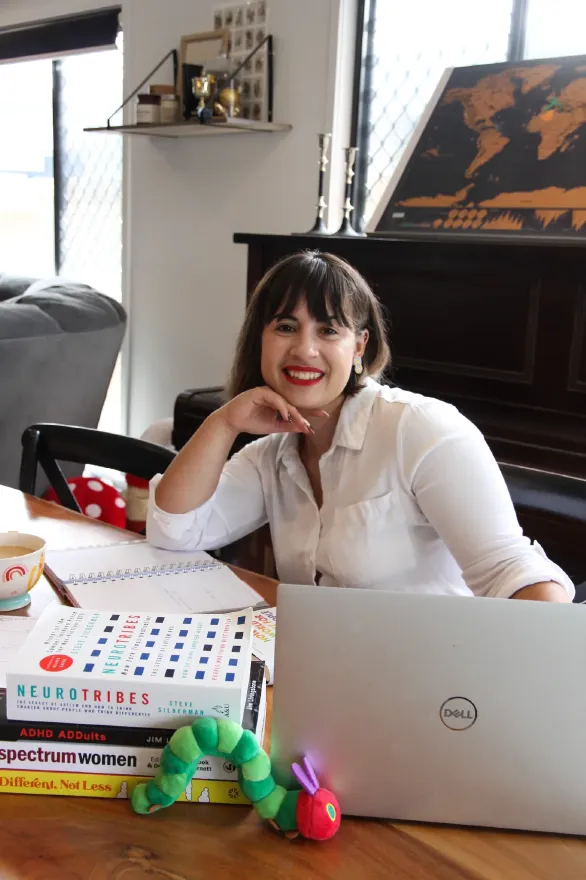
The 2025 Neurodivergent Minds Conference aimed to promote and highlight our community and the incredible work being done to support neurodivergent people. The conference provided an opportunity to share knowledge, celebrate lived experiences and connect with neurodivergent individuals.
Planning for the 2027 Neurodivergent Minds Conference is underway, with exciting opportunities to continue building on the conversations, connections and learnings from our inaugural event. Further information about presenters, program highlights, venue and registration will be shared as details are confirmed.
Cammy Griffin, Let's Talk: Neurodiversity Supports
Interested in presenting at the 2027 Neurodivergent Minds Conference?
If you would like to be considered as a presenter or panellist, we are now welcoming expressions of interest!
Explore our previous conference program below, including the presenters and panellists who shared their knowledge, experiences and insights across the two-day event.
Please note: Program for 2027 TBD.
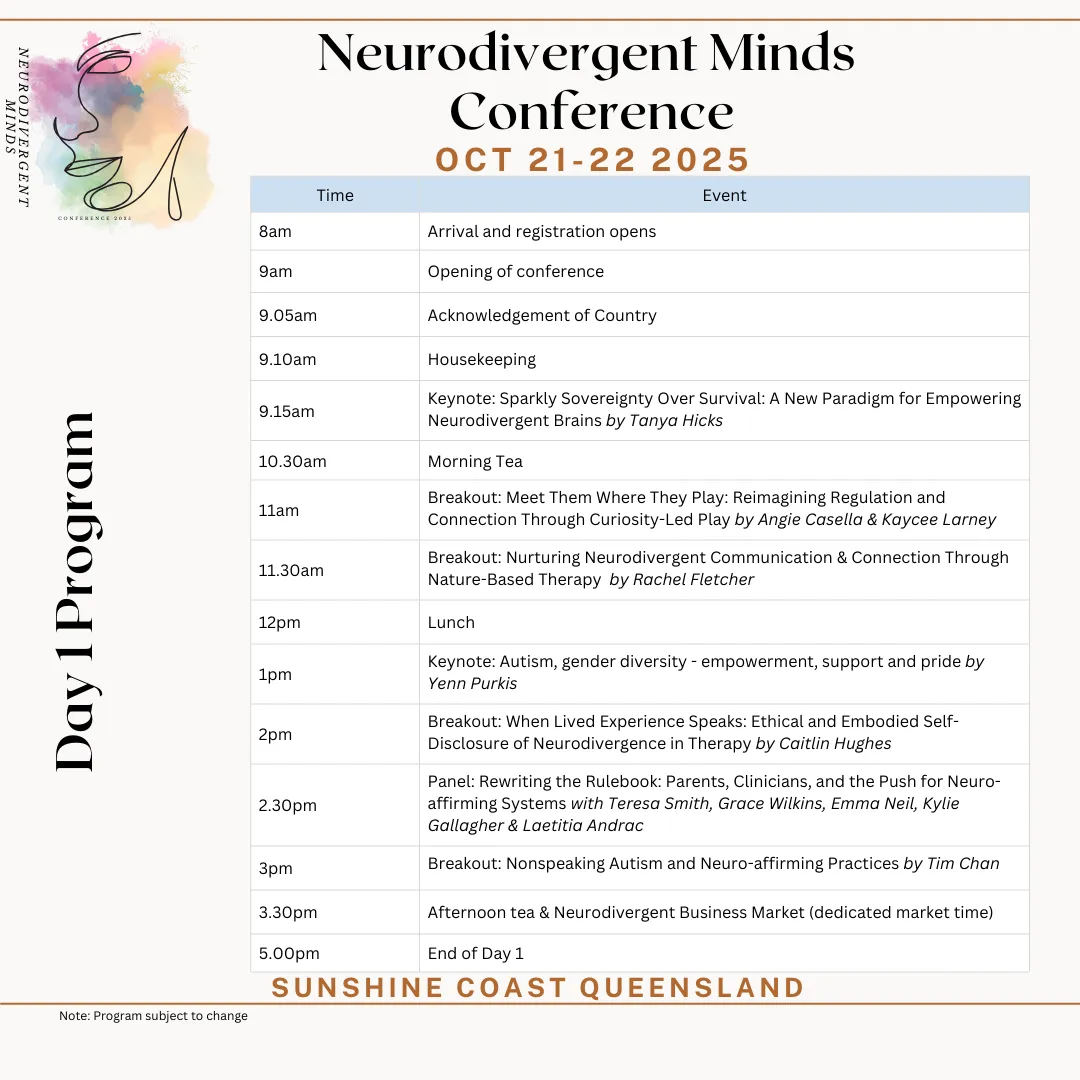
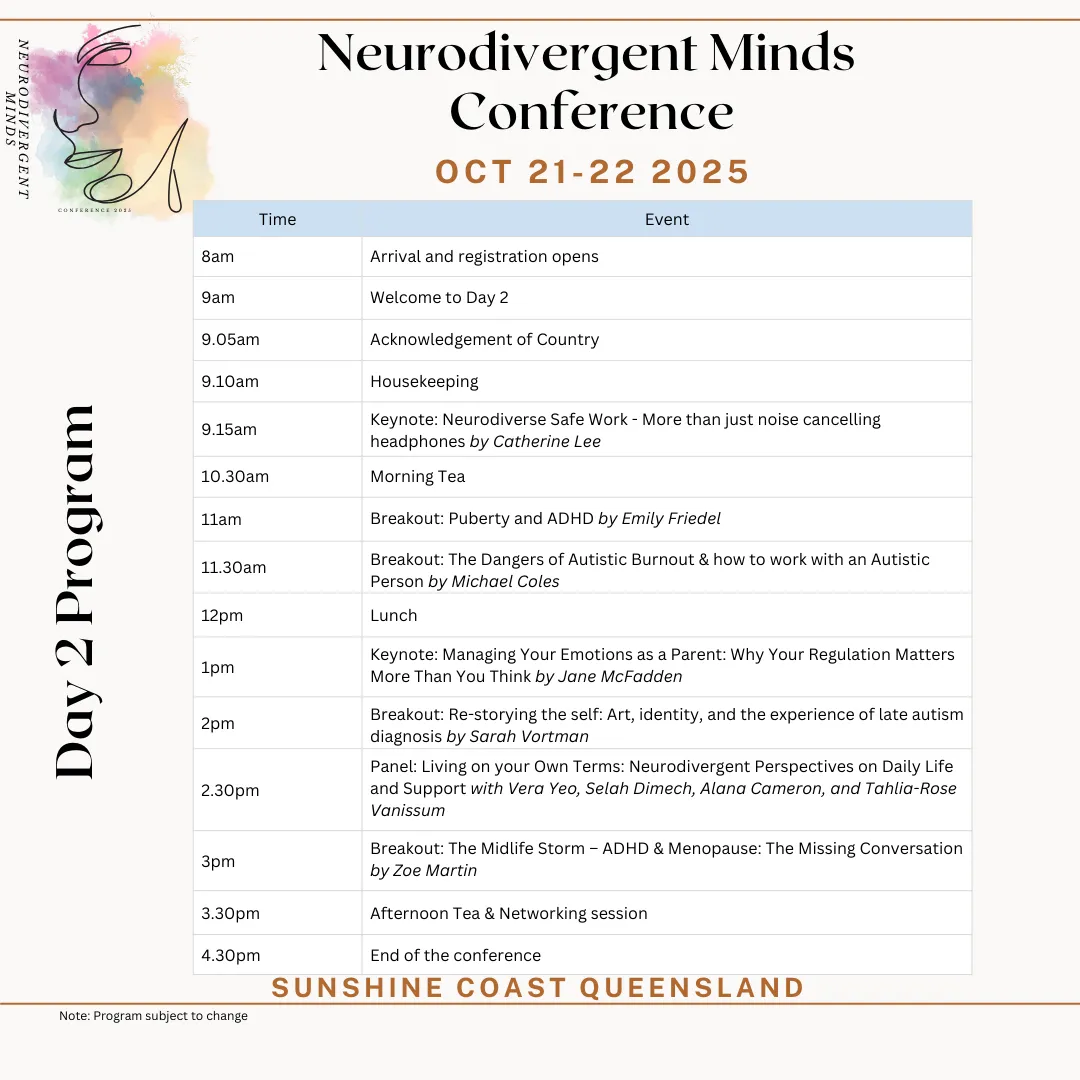
See the full list of presentation topics from our inaugural conference below
Neurodiverse Safe Work - More than just noise cancelling headphones.
This presentation summarises the traditional reactive approaches employers typically adopt in managing neurodivergent workers and explains the limitations with these. A case study illustrates what can go wrong, both for the employer and the Neurodivergent Worker if employers don't get it right. We present the concept of the "Vicious Cycle of Non Disclosure" and describe a more inclusive, proactive approach that employers can utilise to improve their business systems and culture to better accomodate workers who think and function differently.
Meet Them Where They Play: Reimagining Regulation and Connection Through Curiosity-Led Play.
This presentation invites attendees into the world of curiosity-led play, where neurodivergent children are not expected to conform—but are welcomed as they are. Drawing on lived experience as neurodivergent mothers & over 7 years running Curious Me, we’ll explore how sensory-rich, unstructured play environments foster regulation, emotional safety, and genuine connection. Rather than focusing on ‘fixing behaviour,’ this session reframes behaviour as communication & highlights how play can be used as a tool for co-regulation, autonomy, and belonging.
When Lived Experience Speaks: Ethical & Embodied Self-Disclosure of Neurodivergence in Therapy.
This presentation integrates all three elements of the E3BP model. Systematic research, including neurodiversity-affirming scholarship, qualitative research with the inclusion of neurodivergent voices. Clinical practice experience, drawing on my work as an Accredited Mental Health Social Worker supporting neurodivergent clients. Lived experience, including my own journey as an autistic, ADHD, and gifted therapist. By weaving together these forms of evidence, the session models an integrated & neurodivergent-affirming approach to knowledge -one that values rigour, reflection, and real-world resonance.
Autism, gender diversity - empowerment, support and pride.
This presentation will look at Yenn's own life experience as an autistic, ADHD and non-binary advocate, and author. Then focus on experiences & needs of other neurodivergent & Queer people. The presentation will be from a strong neuroaffirming approach & will provide practical strategies for conference delegates around how they can support, include, understand and respect Autistic people who are trans and gender divergent.
Yenn will also draw from the content in their 2023 TEDx talk on Autigender and allies.
See the full list of presentation topics from our inaugural conference below
The Dangers of Autistic Burnout & how to work with an Autistic Person
This presentation invites attendees to share in Michael's journey, where he discusses the difference between Typical Burnout and Autistic Burnout plus providing Strategies for employers to support Autistic employees to help be their authentic selves.
Sparkly Sovereignty Over Survival: A New Paradigm for Empowering Neurodivergent Brains
This presentation offers a new paradigm: one where autistic and ADHD individuals are understood as highly sensitive, highly wired, and often unsupported in systems not built for them. You’ll explore how primal reflexes, polyvagal theory, and trauma-informed stabilisation provide deeper insight into capacity — and why creating safety is the foundation of thriving. Designed for therapists, educators, parents, and neurodivergent adults alike, this keynote is a blend of science, soul, and spark — an invitation to move beyond survival and into embodied truth, connection, and sovereignty.
Managing Your Emotions as a Parent: Why Your Regulation Matters More Than You Think
This keynote will explore the unique challenges of being both neurodivergent and a parent, specifically, how to manage and regulate your own emotions, rather than only focusing on regulating your child. It highlights why self-regulation is so critical, how it impacts the whole family dynamic, and the hidden load parents carry when trying to support their children while holding everything together.
Nurturing Neurodivergent Communication & Connection Through Nature-based Therapy.
This workshop will explore the lived experiences of neurodivergent individuals in finding speech pathology support that is delivered in natural & sensory friendly environments. Research has show that such environments promote communication, rapport, regulation & improved mental & physical wellbeing. Highlighting the benefits of adapting therapy settings to meet sensory & environmental needs. It is hoped that participants of the workshop will leave with a deeper understanding of how environmental factors impact therapeutic outcomes & how to apply these insights to their own practice.
See the full list of presentation topics from our inaugural conference below
Puberty and ADHD
This presentation will broadly cover how puberty may affect AFAB and AMAB individuals, with a focus on how it might be associated with changes in ADHD trait expression and mental health outcomes.
We discuss:
Puberty is a sensitive period for development and may affect adolescents with ADHD differently from their non-ADHD peers.
Puberty may impact AFAB and AMAB adolescents differently in some important ways.
Puberty may be associated with changes in ADHD traits and vulnerability to mental health challenges, potentially indicating a need for additional support/more supportive environments at this time.
Re-storying the self: Art, identity, and the experience of late autism diagnosis
This session shares insights from a recently published PhD study exploring the lived experience of receiving an autism diagnosis in adulthood, using arts-based autoethnography as both method and expression. Through a combination of visual art, personal narrative, and reflective writing, the study investigates how creative practice can support identity, wellbeing, & meaning-making after diagnosis. The session includes a short, optional creative activity—drawing on collage & assemblage as metaphors for the shifting, layered nature of neurodivergent identity. Grounded in neuro-affirming and strengths-based principles, this presentation invites practitioners and peers to consider how art can create space for reimagining identity and self-understanding after diagnosis.
The Midlife Storm - ADHD & Menopause: The Missing Conversation
This keynote explores the lived & often silenced experience of women with ADHD navigating the complex intersection of hormones, identity, & neurodivergence from perimenopause through to post-menopause. With insight, humour, and grounded expertise, Zoe Martin unpacks how declining estrogen levels disrupt dopamine regulation, magnify executive dysfunction, and distort emotional regulation—leaving many women confused, misdiagnosed, and unsupported. This session will challenge outdated narratives, validate the invisible struggles, and call for a new paradigm of hormone-informed, neurodivergent-affirming care. Zoe weaves together science, lived experience, and trauma-informed wisdom to offer a powerful roadmap of reclamation, resilience, and radical self-trust in the final third of life.
Nonspeaking Autism and Neuro-affirming Practices
This presentation, based on lived experience will be used to illustrate & supplement current research into autism & other neurodivergent conditions, to inform policy and practices for inclusion.
The nonspeaking autistic community, comprising 33% of the total autistic population, has traditionally been 'othered" (discriminated and excluded) due to their challenges in communication and daily functioning (CCN and HSN). The sensory processing and movement differences that form the basis of CCN and HSN necessitating support for communication and daily activities will be examined.
Increased understanding will guide policy and practices in neuro-affirmation for this marginalised group.
Tim Chan